

When the world feels uncertain and the stakes are high, creating an environment where people feel safe to speak up can seem almost impossible. Yet research shows that this is precisely when psychological safety matters most. The question is: how will you lead through the safety paradox?
What is Psychological Safety?
Harvard professor Amy Edmondson popularized the concept of psychological safety — a shared belief that team members can take interpersonal risks without fear of embarrassment or punishment. Her studies revealed that teams with high psychological safety learn faster, innovate more, and perform better because members feel free to share ideas, admit mistakes, and ask for help.
This insight was also confirmed by Google’s Project Aristotle, a landmark study on team effectiveness. After analysing hundreds of teams, Google discovered that psychological safety was the single most important factor for success—more critical than technical expertise or raw talent. Teams that felt safe to express themselves were more collaborative, creative, and resilient.
Today, most business leaders agree that psychological safety is desirable. Yet, when challenges intensify or the business environment becomes exceptionally demanding, an underlying assumption often emerges—quietly expressed in private conversations—that, while still desirable, psychological safety is simply impossible under such conditions.
This is an important observation and warrants deeper exploration. If research shows—and we believe—that psychological safety is a critical driver of performance, then it should naturally hold true even during difficult change situations. The question, therefore, is not whether psychological safety matters in such contexts, but how it can be upheld when conditions become most challenging. In other words – how to lead through the safety paradox.
What are Difficult Change Situations?
Difficult change situations refer to organizational contexts where fostering psychological safety becomes exceptionally challenging due to high levels of uncertainty, pressure, or risk. These situations often involve conditions that threaten job security, trust, or stability, making open dialogue and vulnerability harder to achieve. Common examples include:
- Major restructuring or layoffs (actual or anticipated)
- Leadership environments lacking psychological safety (leader navigating in a non-psychologically safe condition)
- Crisis scenarios with extreme financial pressure (e.g., bankruptcy risk or critical funding phases)
- High-speed, high-risk contexts (such as rapid growth in startups or urgent turnaround efforts)
In these scenarios, fear and urgency often dominate, creating a psychological safety paradox: the need for psychological safety is greatest, yet the conditions make it hardest to establish.
In search for a guideline how to navigate this, lets go back to the research:
A Framework for Leaders to make it happen:
Amy Edmondson suggest the following steps for building psychological safety, in the leader´s toolkit for building psychological safety:
1. Setting the Stage
- Frame the work: Help team members understand the nature of the work’s complexity, uncertainty, and interdependence.
- Emphasize purpose: Clarify why the work matters and what shared goals the team is striving for.
- Normalize small failures as part of learning and innovation.
2. Inviting Participation
- Demonstrate situational humility: Show that you don’t have all the answers and welcome others’ insights.
- Practice inquiry-based leadership: Ask open-ended questions to genuinely learn from the team.
- Establish supportive structures: Use formats (like round-the-table or check-ins) that encourage everyone’s voice.
3. Responding Productively
- Express genuine appreciation: Acknowledge contributions and reinforce speaking up.
- Destigmatize failure: Treat mistakes as valuable learning moments rather than reasons for blame.
- Sanction respectful norms: Address speech or behaviours that undermine safety to reinforce a culture of trust.
So, the “Why” for psychological safety has been described and discussed in detail, and there is a conceptual framework (leader´s toolkit) for the “What” to do as a leader to generate psychological safety. Now – to be applicable in difficult change situations, lets dive deeper into the “How”.
Practical moves to put psychological safety into reality:
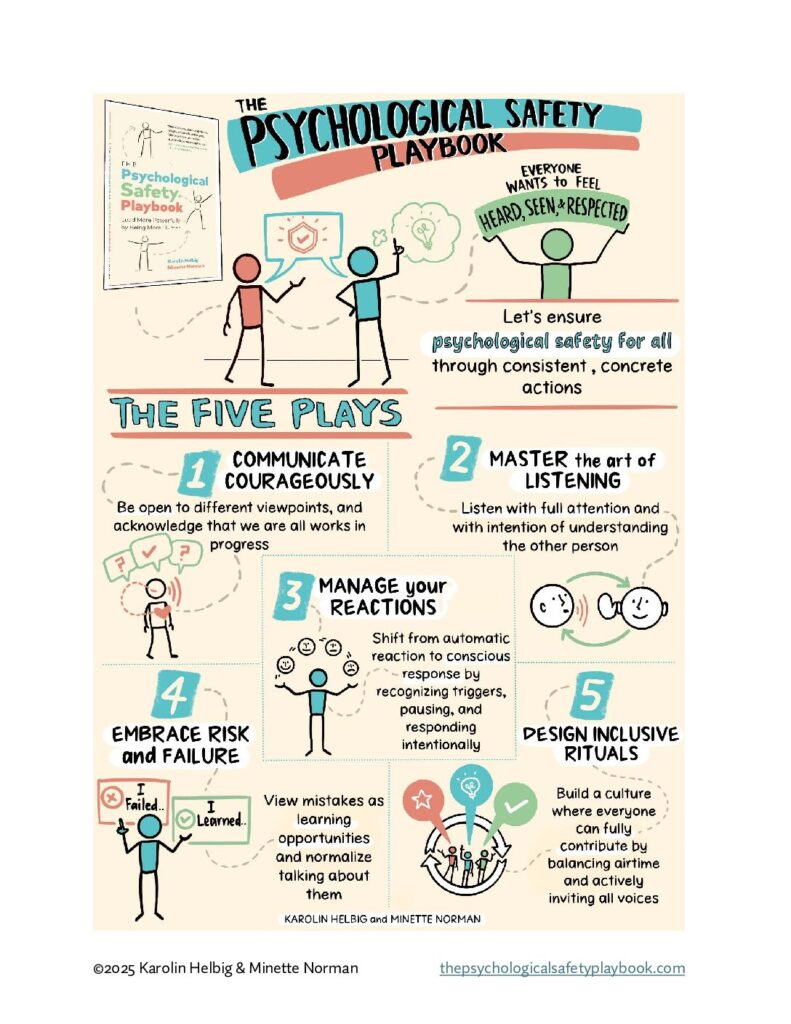
In the Psychological Safety Playbook, Karolin Helbig and Minette Norman provide a practical toolkit for applying certain, so called “moves” for use in everyday life. The focus is on practical, hands‑on approaches that establish reproducible behaviors and routines, integrating psychological safety into everyday work. We will now examine these practices, organized into five major plays.
Play #1: Communicate Courageously
- Welcome other viewpoints: “What am I missing?”
- Solicit diverse perspectives: “That´s one viewpoint; lets hear some dissent”
- Open up: Express your own emotions
- Take off the mask of perfection: “I don’t know yet”
- Nurture a sense of Humor at work: Laugh more (especially at yourself)
Play #2: Master the art of listening
- Listen to Understand – Develop the discipline of not preparing a response
- Be fully present – Tame your wandering mind
- Clarify your understanding – articulate what you heard
- Listen for emotions – Hear what is not being said
- Commit to Curiosity: Tell me more
Play #3: Manage your reactions
- Model Non-defensive Reactions: Hit the Pause Button
- Respond Productively: Label your Emotions
- Watch out for your blind spots: “What stories am I telling myself?”
- Appreciate being challenged: Thank people for their courage
- Build on others ideas: “Yes, and”
Play #4: Embrace risk and failure
- Normalize Failure: “This is new to us, so we will experience failure”
- Reframe Failures as learning opportunities: “Interesting! What can we learn from this?”
- Get comfortable with discomfort: Welcome difficult emotions
- Model Learner Behavior: Admit mistakes and shares lessons learned
- Celebrate Continuous Learning: Implement blameless postmortems
Play #5: Design inclusive rituals
- Upgrade Meetings: Appoint an inclusion booster
- Respect all voices: Establish a No-Interruption Rule
- Take Turns: No one speaks twice until everyone speaks once
- Check for Psychological Safety: Gather feedback after meetings
- Appreciate the team: Express gratitude
Now, let us examine whether these practices are applicable in difficult change situations, as defined above, and whether they require adaptation to be effective. In this article series, we will review each proposed play individually and evaluate—using real-life examples—whether:
- It is feasible and actionable in difficult change situations, and
- How it can be implemented in a practical and meaningful way during such periods.
In our next article in the safety paradox series, we will start to elaborate, how the moves can be applied during major restructuring.