
There is a word that, unfortunately, has become part of our vocabulary in recent years: polycrisis. It describes several crises happening at the same time, overlapping and reinforcing each other.
Wars in Europe and the Middle East. Climate change. Trade tensions and geopolitical uncertainty. A technology revolution that changes how we work faster than most of us can keep up. Together, they create a constant background noise of uncertainty that shows up as anxiety, worry and a feeling of losing control. In Gallup’s State of the Global Workplace 2026, 40% of employees worldwide said they had experienced a lot of stress the previous day.
From Polycrisis to Polytransformation
What I observe in many organizations is a similar phenomenon. I call it polytransformation: AI, Digitalization, Supply chain adjustments, Cost programs, Reorganizations, New ERP systems, New ways of working.
All of them happen for good reasons. Yet they often overlap, compete for the same resources, and “hit” the same people: the middle managers, the key experts, the teams that keep daily business running.

Why Change Fatigue Keeps Growing
Research confirms what many of us feel. According to Gartner, the average employee experienced 10 planned enterprise changes in 2022, up from two in 2016. Over the same period, employees’ willingness to support change fell from 74% to 43% (Harvard Business Review, 2023). Change-fatigued employees show lower trust, less willingness to go the extra mile, and lower intent to stay (Gartner, 2023).
In other words: we keep adding change, while people’s willingness to support it is shrinking. Or, as I often hear: “Before we can even stabilize and harvest from one initiative, we already jump to the next.”
The effects are real:
- Change exhaustion and stress
- Cynicism: “Here comes the next initiative…”
- Competing priorities and unclear trade-offs
- Loss of overview, and with it, loss of meaning
So how do we lead when everything changes at once?
Purpose: The Anchor in Polytransformation
Many of these transformations are necessary, so we can’t simply stop all of them. But we can help people make sense of them. When the what and the how change constantly, people need something that doesn’t: a clear why.
In times of polytransformation, a clear purpose does three things:
- It gives direction. It helps us decide which changes matter most, and which can wait.
- It connects. It turns many separate initiatives into one story people can understand.
- It gives people something to lean back on when the ground is moving.
But a clear purpose alone doesn’t create capacity. What happens when, even though we know what matters most, the list of initiatives keeps growing?
Subtraction: The Overlooked Leadership Competence
If purpose helps us see what matters, subtraction is the courage to act on it. When things get complex, our instinct is to add: one more initiative, one more steering committee, one more KPI. A study published in Nature found that people systematically overlook subtractive solutions, even when removing something would be the better fix (Adams et al., 2021).
In times of polytransformation, subtraction becomes a critical leadership competence. Every new transformation should come with the question: What will we stop doing to make room for it? Stopping a project, merging initiatives, cancelling a meeting series, simplifying a process. It takes courage, and it is one of the most powerful ways a leader can give people back focus, energy and capacity.
This is also one of the six practices identified in a comprehensive study Transformations that work, (HBR, 2024): “In successful programs leaders explicitly identify the employees and functions that will be most impacted by each aspect of the initiative and ensure that no group is expected to alter multiple routines at once. Changes are carefully sequenced to limit disruption and prevent widespread organizational fatigue”.
What Operational Excellence Teaches Us
Operational Excellence offers two principles that help in times of polytransformation.
The first is True North: the guiding direction that never changes, even when targets, projects and methods do. In strategy deployment (Hoshin Kanri), every initiative should be traceable back to True North. If it isn’t, that’s a signal to question it.
The second is limiting work in progress. In operations, we know that too much work in parallel slows down flow, increases errors and creates waste. Yet in many organizations, we run five, eight or ten transformations in parallel and wonder why none of them deliver as planned.
In my experience, the most effective leadership teams are as rigorous about not adding, or taking things away, as they are about kicking off new activities. In times of polycrisis and polytransformations, this discipline becomes more relevant than ever. This was also confirmed in a comprehensive study
Polytransformations are, in a way, a work-in-progress problem at leadership level. Purpose tells us where True North is. Subtraction is how we limit work in progress.
A Practical Reflection Exercise for Your Team: The Purpose Thread
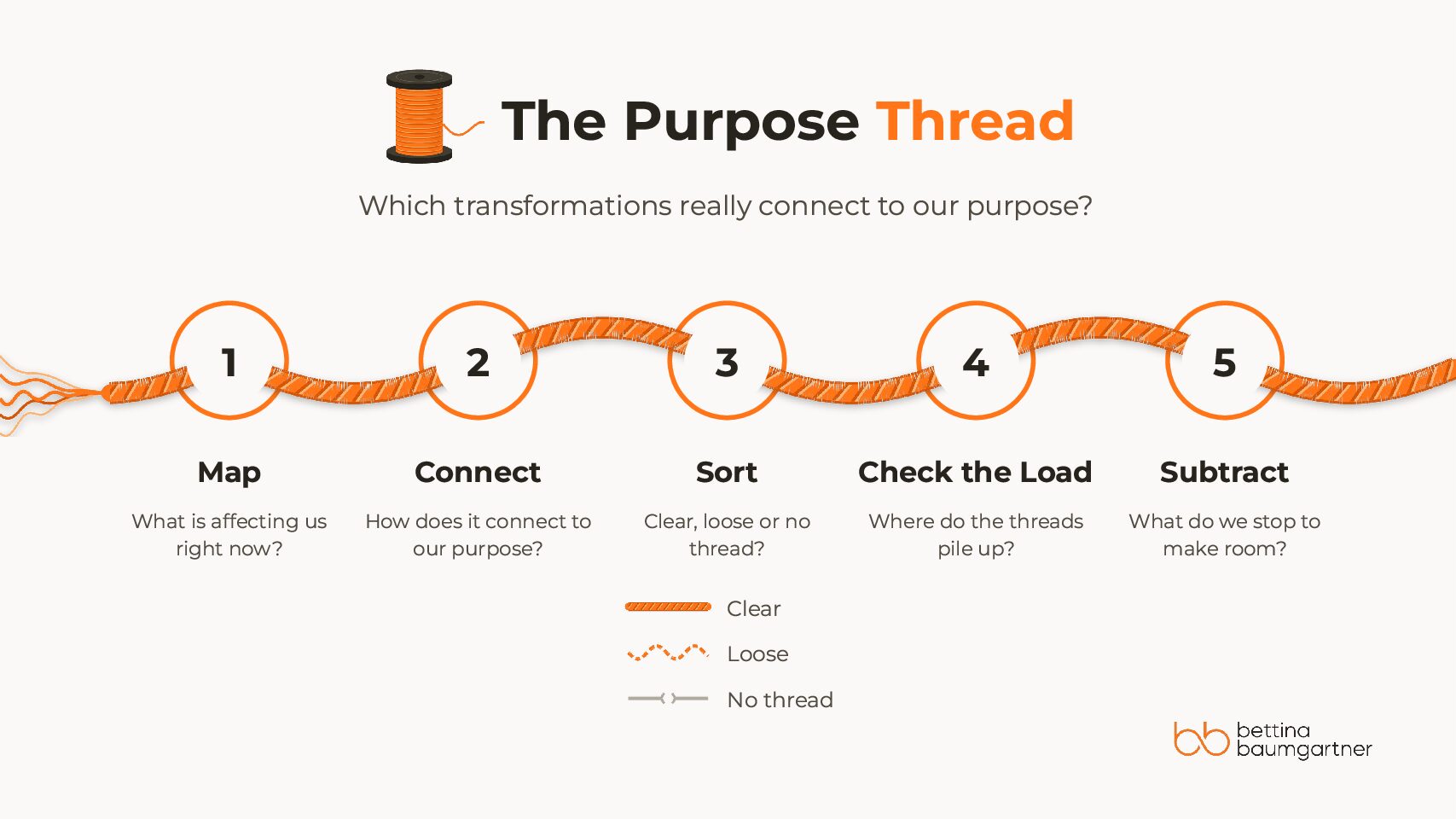
Which of your transformations are really connected to your purpose? This exercise helps you and your team find out, and see where the load piles up.
- Map it. List all transformations, programs and initiatives currently affecting your team on one page. Everything, including the “small” ones.
- Connect it. For each initiative, ask: How does this connect to our purpose? Can we explain the link in one sentence?
- Sort it into three groups:
- Clear thread: the link to our purpose is obvious. Communicate it, again and again.
- Loose thread: there is a link, but we can’t explain it well. Clarify it with whoever is driving the initiative.
- No thread: a candidate for subtraction. Can it be paused, merged or stopped?
- Check the load. Mark who is affected by each initiative. Where do the threads pile up on the same people?
- Subtract. For every initiative you keep, agree on one thing the team will stop doing to make room for it.
The goal is to make sure people can see the thread that holds it all together, and have the capacity to follow it.
Closing Thoughts
We cannot stop the polycrisis. And many of the transformations in our organizations are necessary. But we can choose how we lead through them.
When the what and the how keep changing, people need a why that doesn’t. Purpose is the anchor that tells us what matters. And once we know what matters, we also need the courage to let go of what doesn’t.
Purpose shows us what to hold on to. Subtraction gives us room to do it well.
Leadership reflection:
- How many transformations are currently “hitting” my team at the same time?
- Can I explain how each of them connects to our purpose?
- What is one thing I could stop, pause or simplify this month to give my team more focus and energy?
This article is based on the October issue of our newsletter, The Transformation Brief. If you’d like practical tools and reflections on transformation, operational excellence and psychological safety in your inbox every month, subscribe here.
Read more about how leaders can create a sense of safety for their teams when the world around them feels anything but safe in The Safety Paradox: 3 Steps for Building Safe Spaces in Unsafe Times.


